
The Head and Shoulders Chart Pattern: Complete Trading Guide
Summary
Head and Shoulders Pattern (Bearish Reversal): Forms after an uptrend with three peaks - left shoulder, head (highest peak), and right shoulder. Breaking the neckline (line connecting the two troughs between peaks) confirms the reversal and triggers the entry signal. Traders place stop-loss above the right shoulder and target profit based on the pattern's height.
Inverse Head and Shoulders (Bullish Reversal): Mirrors the regular pattern but inverted, forming after a downtrend with three troughs - left shoulder, head (lowest trough), and right shoulder. Breaking the neckline upward confirms the bullish reversal.
Pattern Requirements: Valid head and shoulders patterns need clear volume confirmation on the neckline break, a properly formed neckline (can be sloping or flat), and three distinct peaks or troughs. The pattern works across all timeframes but performs differently on each.
Entry Strategies: Three main approaches exist - entering on the neckline break, waiting for a candle close beyond the neckline, or waiting for a retest of the neckline after the break. Each approach offers different risk-reward profiles.
Stop-Loss Approaches: Super aggressive stops (just above the entry candle) offer tighter risk but lower win rates around 54-55%. Conservative stops (above the right shoulder) offer higher win rates but lower risk-reward ratios around 3:1.
Pattern Reliability: Head and shoulders patterns rank among the most trusted reversal formations in trading because they reveal institutional distribution (bearish) or accumulation (bullish) at key turning points. According to Investopedia, these patterns are essential in identifying trend reversals, as they highlight shifts in market sentiment driven by institutional players. The pattern can also signal trend continuation under specific conditions.
What the Head and Shoulders Pattern Is
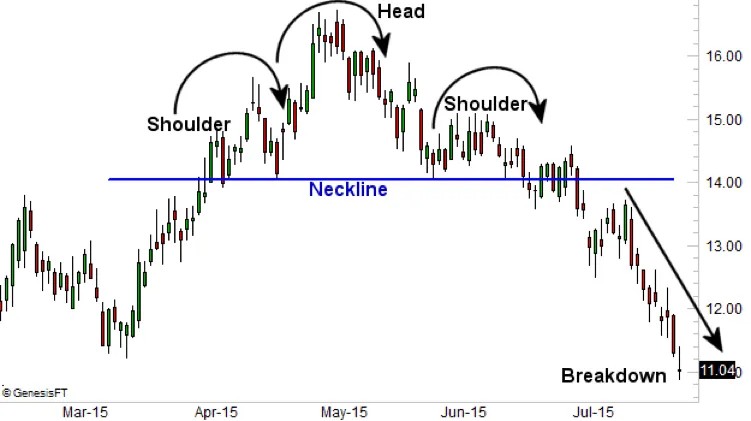
The head and shoulders pattern appears on price charts when a trend is ending and about to reverse. The pattern looks like a human head with two shoulders on either side. For a bearish reversal, you see three peaks. For a bullish reversal, you see three troughs.
The pattern forms because institutional money is shifting positions. Banks and hedge funds can't just dump their entire position at once. They distribute slowly at the top (for bearish patterns) or accumulate slowly at the bottom (for bullish patterns). This creates the distinctive three-peak or three-trough formation you see on your chart.
What makes head and shoulders patterns powerful is how clearly they show this institutional behavior. The left shoulder represents the first sign of weakness. The head shows one final push higher (or lower) before momentum completely dies. The right shoulder confirms that the trend is done. When price breaks the neckline, you're seeing the beginning of the new trend.
The Regular Head and Shoulders (Bearish)
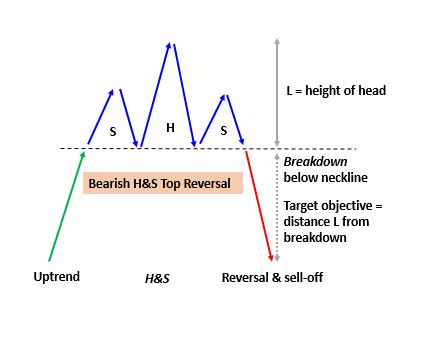
The regular head and shoulders forms after an uptrend and signals a bearish reversal. Here's how it develops:
Left shoulder: Price rallies to a new high during the uptrend, then pulls back to form a trough. This looks normal. The uptrend appears healthy.
Head: Price rallies again and makes an even higher high. This is the final push by buyers. Then price drops back down, often more aggressively than the first pullback. This forms the second trough.
Right shoulder: Price rallies one more time but fails to reach the head's height. This lower high is the critical warning sign. Buyers are losing control. Price drops again.
Neckline: Draw a line connecting the two troughs (the low points between the peaks). This is your neckline. It can slope upward, downward, or be flat. All are valid.
When price breaks below the neckline, the pattern is confirmed. The reversal is happening.
The Inverse Head and Shoulders (Bullish)
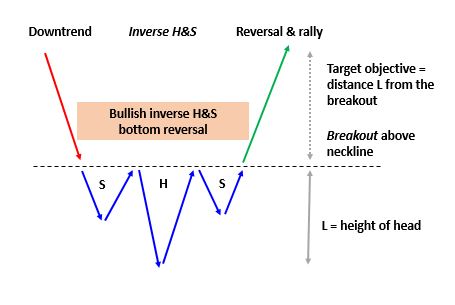
The inverse head and shoulders is the mirror image. It forms after a downtrend and signals a bullish reversal. Here's the formation:
Left shoulder: Price drops to a new low during the downtrend, then bounces to form a peak. The downtrend still looks intact.
Head: Price drops again and makes an even lower low. This is the final capitulation by sellers. Then price bounces back up, often more aggressively than the first bounce. This forms the second peak.
Right shoulder: Price drops one more time but doesn't go as low as the head. This higher low is the first sign that sellers are losing control. Price bounces again.
Neckline: Connect the two peaks (the high points between the troughs). This is your neckline for the inverse pattern.
When price breaks above the neckline, the pattern is confirmed. The bullish reversal is starting.
Why These Patterns Work
Head and shoulders patterns work because they reveal the exact moment institutional money completes its distribution or accumulation. The left shoulder shows institutions starting to exit their positions (or cover shorts). The head shows the final distribution (or accumulation). The right shoulder shows that they're done and the trend is reversing.
The neckline represents a psychological level where retail traders are still defending the old trend. When price breaks through this level, those traders get stopped out. Their forced exits add fuel to the new trend, creating the aggressive move away from the neckline that makes these patterns profitable.
How to Identify Valid Head and Shoulders Patterns
Not every three-peak formation is a head and shoulders pattern. You need specific criteria to separate real patterns from noise.
Pattern Requirements
A valid head and shoulders pattern must have these components:
Three distinct peaks or troughs: The middle peak (head) must be noticeably higher than the two shoulders in a regular pattern. The middle trough (head) must be noticeably lower than the two shoulders in an inverse pattern. If all three are roughly the same height, you don't have a head and shoulders. You have a triple top or triple bottom.
Clear neckline: You must be able to draw a clean line connecting the two troughs (regular pattern) or two peaks (inverse pattern). The neckline doesn't need to be perfectly horizontal. It can slope up or down. But it needs to be clear and unambiguous.
Symmetry between shoulders: The left and right shoulders should be roughly similar in height and shape. They don't need to be identical, but they should be close. If the right shoulder is significantly higher or lower than the left, the pattern is weaker.
The Neckline
The neckline is the most critical part of the pattern. Here's what you need to know:
How to draw it: Connect the lowest points (for regular H&S) or highest points (for inverse H&S) between the three peaks or troughs. Use the candle bodies, not the wicks, for the most accurate neckline.
Sloping necklines are valid: Your neckline doesn't need to be flat. An upward-sloping neckline in a regular H&S or a downward-sloping neckline in an inverse H&S is perfectly valid. The slope doesn't change how you trade the pattern.
The neckline is your trigger: The neckline break is what confirms the pattern and triggers your entry. Before the break, you're just watching a potential pattern form. After the break, you have confirmation.
What Invalidates the Pattern
Sometimes what looks like a head and shoulders pattern doesn't actually complete. Here's when the pattern is invalidated:
New peak above the head: For a regular head and shoulders, if price makes a new high above the head before breaking the neckline, the pattern is dead. The uptrend is continuing, not reversing.
New trough below the head: For an inverse head and shoulders, if price makes a new low below the head before breaking the neckline, the pattern is invalidated. The downtrend continues.
Price moves sideways too long: Head and shoulders patterns need to complete within a reasonable timeframe. If price just sits at the neckline for weeks without breaking through, the pattern loses its power. The momentum that makes these patterns work dissipates.
VIDEO: Watch the Complete Head and Shoulders Trading Breakdown See exactly how to trade head and shoulders patterns with The Trading Cafe's proven method, including entry timing, stop-loss placement, and using Fibonacci for irregular patterns. https://www.skool.com/thetradingcafe/classroom/282a34a6?md=6a96dfb2d1c744b19ab527980b6893b2
Entry and Exit Rules for Head and Shoulders Trades
Let's get specific about entries and exits. Here are the exact rules.
Entry Rules
Rule 1: Break entry Enter when price breaks the neckline. Use a pending order placed just beyond the neckline. For regular H&S, sell order below neckline. For inverse H&S, buy order above neckline.
Rule 2: Close entry Enter after a candle closes beyond the neckline. This means waiting for confirmation but giving up the best entry price. For regular H&S, enter after a candle closes below the neckline. For inverse H&S, enter after a candle closes above the neckline.
Rule 3: Retest entry Enter after price retests the neckline and shows rejection. Wait for an entry setup candle (pin bar, engulfing) at the neckline after the initial break. This is the most conservative approach.
Stop-Loss Rules
Aggressive approach: Stop 5-10 pips beyond the entry candle. For regular H&S, stop above the entry candle. For inverse H&S, stop below the entry candle. Tighter risk, lower win rate (54-55%), better risk-reward (3:1).
Conservative approach: Stop beyond right shoulder. For regular H&S, stop above right shoulder high. For inverse H&S, stop below right shoulder low. Wider risk, higher win rate, lower risk-reward (1:1 to 1.5:1).
Add buffer for spread. If your broker spread is 2-3 pips, add that to your stop distance. If your spread is tighter (0.5-1 pip), you can use a smaller buffer.
Take-Profit Rules
Measure pattern height. From head to neckline. Project that distance from the neckline break point. That's your target.
For aggressive stops, aim for full target (3:1 or better). Don't exit early. You need the big winners to compensate for the lower win rate.
For conservative stops, aim for 1:1 to 1.5:1. Exit at your predetermined target. Don't hold hoping for more.
Trading Cafe Head and Shoulders Checklist
Before taking any head and shoulders trade, verify:
Pattern has three distinct peaks (or troughs)
Head is noticeably higher/lower than shoulders
Shoulders are roughly symmetrical
Neckline is clear (can be sloping)
Entry setup candle formed (for retest entries)
Stop-loss placement decided (aggressive or conservative)
Target calculated (pattern height from neckline)
Risk is 1-2% of account maximum
If all 10 items check out, take the trade. If even one is missing, skip it.
Why Head and Shoulders Patterns Fail
Even valid-looking head and shoulders patterns fail sometimes. Here's why, and how to avoid these setups.
Reason 1: False Neckline Breaks
Sometimes price breaks the neckline briefly, then immediately reverses back. This false break stops out traders who entered on the initial break. Then price continues in the old trend direction as if the pattern never existed.
Change to 'False breaks happen most often in currencies, commodities and indices. Therefore the immediate break entry is only effective on stocks.
The retest entry strategy helps avoid false breaks. By waiting for price to break, retest, and then show rejection with an entry setup candle, you confirm the break is real before risking money.
Reason 2: Pattern Invalidation
Sometimes what looks like a complete head and shoulders develops a new peak or trough before breaking the neckline. This invalidates the pattern.
For regular H&S, if price makes a new high above the head, the pattern is dead. The uptrend is continuing. For inverse H&S, if price makes a new low below the head, the pattern is invalidated. The downtrend continues.
Watch for this as the pattern develops. If you see price starting to push above the head (or below for inverse), don't wait for the neckline break. The pattern is already failing. Cancel any pending orders and look for different setups.
Reason 3: Neckline Retest That Reverses
After the neckline breaks, price often returns to test it. A strong rejection at the neckline leads to continuation in the new trend direction. If price reclaims the neckline and holds above it, the pattern fails.
You can't predict which retests will hold and which will reverse. This is why the aggressive stop-loss strategy (stop just beyond the entry candle) has a lower win rate. Some retests will tag your stop before the price continues in your direction. Other retests will actually reverse the pattern.
The conservative stop strategy (stop beyond the right shoulder) gives you room to survive most retests. But you sacrifice risk-reward ratio to get that safety.
Reason 4: Pattern Takes Too Long
Head and shoulders patterns need to complete within a reasonable timeframe. If price sits at the neckline for too long without breaking through, the pattern loses power. The momentum that drives these reversals dissipates.
If your pattern has formed over too many candles, consider it dead. Cancel any pending orders and look for fresh setups. The longer price hesitates at the neckline without breaking, the less likely the pattern is to produce a profitable trade.
Best Timeframes for Head and Shoulders Trading
Head and shoulders patterns work on all timeframes, but each has different characteristics.
15-Minute Timeframe
Head and shoulders on the 15-minute gives you multiple setups per day across your watchlist. The patterns form quickly (usually within 2-4 hours) so you're not waiting days for a setup to complete. Stop-losses are small enough that even with broker spreads, the math works in your favor.
The challenge with 15-minute patterns is they require more attention. You need to monitor your watchlist regularly to catch patterns as they form. If you can only check charts once or twice a day, the 15-minute is too fast.
Your broker spread matters more on 15-minute charts. The 10% rule applies: your spread must be less than 10% of your stop-loss distance. If your stop is 10 pips and your spread is 2 pips, you're at the edge. Tighter spreads work better for 15-minute head and shoulders trading.
1-Hour Timeframe
The 1-hour chart is a good balance for traders who can't watch 15-minute charts all day. Patterns take 4-12 hours to form. You can check charts 2-3 times per day and still catch most setups.
Stop-losses on 1-hour patterns are typically 20-40 pips. With a 2-pip spread, that's only 5-10% of your stop distance. The spread becomes less of a factor.
You'll see fewer setups on 1-hour charts compared to 15-minute ones. Maybe 5-10 setups per week across a 40-instrument watchlist instead of multiple setups per day. But the quality is often higher because 1-hour patterns have more time to develop properly.
4-Hour Timeframe
The 4-hour chart produces even fewer head and shoulders patterns, maybe 3-5 per week. But these patterns are more reliable because they represent bigger market moves. Stop-losses are larger (50-100 pips) but your risk-reward improves.
The 4-hour is perfect for traders with full-time jobs. You can check charts morning and evening. Patterns take 1-3 days to form, giving you plenty of time to spot them and prepare your trades.
Daily Timeframe
Daily head and shoulders patterns are rare. You might see 1-2 per month across your entire watchlist. But when they appear, they're powerful. These patterns represent major trend reversals that can last weeks or months.
The challenge is patience. A daily head and shoulders might take 2-3 weeks to form fully. You need conviction to hold through that process. Most traders are better served focusing on lower timeframes for more frequent opportunities.
Which Timeframe Is Best?
For active traders who can monitor charts during the day: 15-minute is best. You get multiple setups daily and can compound gains quickly.
For part-time traders who check charts 2-3 times per day: 1-hour is best. Good balance of opportunity and manageability.
For traders with full-time jobs: 4-hour is best. Check charts morning and evening, catch quality setups without constant monitoring.
Risk Management for Head and Shoulders Trading
Head and shoulders patterns give you an edge, but without proper risk management, you'll still lose money.
Position Sizing
Never risk more than 2% of your account on a single head and shoulders trade. 1% is better when starting out.
Here's the formula:
Your risk amount ($100 in this example) is the maximum you can lose. Not your position size. Many beginners confuse these and end up over-leveraged.
Choosing Your Stop-Loss Approach
The aggressive stop approach (just beyond the entry candle) and conservative approach (beyond right shoulder) produce different results. Here's how to decide:
Use aggressive stops if you want bigger risk-reward ratios (3:1 or better) and can handle lower win rates (54-55%). This approach works better on lower timeframes (15-minute, 1-hour) where patterns move quickly to target.
Use conservative stops if you want higher win rates and can accept smaller risk-reward ratios (1:1 to 1.5:1). This approach works better on higher timeframes (4-hour, daily) where giving the pattern room to retest makes sense.
Your trading personality matters. If seeing 4-5 losing trades in a row frustrates you, use conservative stops for the higher win rate. If you're disciplined enough to wait for the occasional big winner, aggressive stops offer better long-term returns.
Maximum Open Trades
Limit yourself to 2% maximum total risk exposure at any one time on correlated positions. More than that and you're over-exposed. If market conditions shift and patterns start failing, you'll take multiple losses simultaneously.
Quality over quantity. With a 40-instrument watchlist, you'll see plenty of head and shoulders patterns forming. Be selective. Only trade the best setups that meet all your criteria.
Taking Profits
When price hits your target, exit. Don't hold hoping for more. Head and shoulders patterns work because they hit their measured targets consistently. If you start holding for bigger moves, your win rate drops and you give back profits.
The aggressive stop approach requires discipline. You'll lose more trades, so you must let winners run to full target. Exiting early destroys the strategy's edge.
The conservative stop approach allows some flexibility. You can take partial profits at 1:1 and hold a portion for 1.5:1 or 2:1. But the default should be exiting at your predetermined target.
How to Practice Head and Shoulders Patterns
Reading about head and shoulders is different from spotting them in real-time. You need a practice system.
Use Bar Replay Mode
TradingView has a bar replay feature that hides future price data. This lets you practice identifying patterns without knowing what happens next.
Here's how:
Open TradingView and select a currency pair or stock
Go back 6-12 months
Click the bar replay button
Price data after your date disappears
Identify head and shoulders patterns as they form
Play forward one candle at a time
This builds your ability to spot patterns as they develop, not just after they're complete. That's the skill that makes money.
Document Your Patterns
Create a spreadsheet to track every pattern you find:
Pattern number
Instrument
Timeframe
Date identified
Screenshot link
Entry method used (break/close/retest)
Stop-loss approach (aggressive/conservative)
Did it reach target? (Yes/No)
Notes on what happened
When you spot a pattern in bar replay, take a screenshot. Paste the link in your spreadsheet. Play forward and see if the pattern reached target. Record what happened.
After documenting 50-100 patterns, you'll see which types work best. You'll notice your common mistakes. This feedback loop is how you improve.
Practice Progressive Complexity
Don't try to learn everything at once. Break it down:
Week 1: Just identify head and shoulders patterns. Don't worry about entries or exits. Practice seeing the three peaks or three troughs and drawing the neckline. See our entry guide here.
Week 2: Add entry timing. Practice deciding which entry method (break/retest) fits each pattern.
Week 3: Add stop-loss placement. Decide aggressive vs conservative for each pattern and mark where your stop would go.
Week 4: Put it all together. Simulate complete trades with entries, stops, and targets.
This progression builds competence without overwhelming you.
Test Multiple Timeframes
Practice on different timeframes to see how patterns behave. Spend a week on 15-minute charts. Then a week on 1-hour one. Then 4-hour. You'll discover which timeframe fits your trading style best.
Different instruments behave differently too. Practice on 5-6 major currency pairs or stocks. Some are choppy. Some trend smoothly. You need experience with both.
Final Thoughts
The head and shoulders pattern works because it shows you the exact moment institutional money completes its distribution or accumulation. You're not guessing where the price might reverse. You're identifying specific formations that consistently produce the same result.
But like any strategy,(see our guide on day trading strategies) it only works if you apply it correctly. You need to wait for proper entry signals. You need to choose between aggressive and conservative stops based on your timeframe and personality. You need proper risk management. And you need to practice until pattern recognition becomes second nature.
Most traders fail because they skip these steps. They see one good example and think they're ready. Then they lose money and blame the pattern. Don't be like them.
At The Trading Cafe, we teach you to practice first. Document 300 patterns using bar replay. Build your pattern recognition skills. Test both stop-loss approaches to see which fits your style. Only after you've proven consistency in practice do you risk real money.