
How to Read Stock Market Charts (2026 Guide)
A stock chart is simply a visual map of how a stock’s price has moved over time. It shows the open, high, low, close, and volume. When you learn how to read stock charts, you start seeing where the price has been and how traders reacted at key levels. You understand the movement instead of guessing. This gives you a clearer way to plan entries and exits and react to what the market is doing in real time.
When you’re trading intraday, price moves fast, so being able to glance at a chart and grasp the trend is key.
Charts bundle lots of information (price, time, volume, patterns) in one place, so you don’t have to dig through pages of numbers.
Misreading a chart means entering late or exiting late, both of which cost money. Chart literacy reduces that risk
The 3 Main Types of Stock Charts
You’ll see three main chart styles when you open your platform. Each one shows price differently, and each one helps you read movement with a different level of detail. You don’t need to master all three, but you should know how they work so you can choose the view that fits your trading style.
Line Chart
A line chart connects each closing price across the timeframe you’re viewing. Each point is marked at the close of the timeframe selected. For example, on the 1-hour chart, a new point appears at the end of every hour. Line charts give you a quick view of overall direction, but they lack detail about intraday movement, highs, lows, and volatility.
Bar Chart (OHLC)
A bar chart shows four key numbers for each period: the open, high, low, and close. Each bar has a vertical line (the high-to-low range) with small marks indicating the open and close. You get more detail than a line chart, which helps when you want to see how far price moved inside each candle.
Candlestick Chart
A candlestick chart shows the same information as a bar chart, but it’s easier to read at a glance. The “body” of the candle shows the open-to-close range, and the “wicks” show the highs and lows. This style is the most common for day traders because it makes shifts in momentum, strength, and rejection easier to spot quickly.
How to Read Timeframes
When you look at a stock chart, every candle or bar represents a fixed block of time. This block is called the timeframe. The chart updates once the timeframe ends, which creates a new candle with fresh price data.
Each candle still shows the open, high, low, and close for that period; you’re just changing the size of the window you’re looking at.
Example:
On the 1-hour chart, you’ll see one candle for 10:00–11:00, then the next candle for 11:00–12:00. At 12:00, a new candle starts forming. That’s why the chart gets smoother on higher timeframes and more detailed on lower ones.
Where beginners get confused
People often think a “5-minute chart” means the stock moves every five minutes. It doesn’t. The stock moves constantly. The chart simply collects that movement into one candle for each five-minute block.
How traders use different timeframes
Day traders usually read charts in layers:
You use a higher timeframe (like the daily or weekly chart) to see the overall trend.
You drop down to the 15-minute or 1-hour chart to plan entries and exits.
You confirm momentum by checking how candles behave across both views.
“This ‘top‑down’ approach keeps you from entering blindly on a small timeframe that might be sitting inside a bigger trend reversal, and you can use just one higher timeframe only (this is what the SID method does).
How to Read the Axes & Volume
When you look at a chart, the axes tell you when the price moved and how far it moved. Understanding both makes the rest of the chart much easier to follow.
X-Axis (Time)
The x-axis runs left to right and shows the timeline of your chart. Each candle represents the timeframe you selected.
If you’re on the 1-minute chart, every candle covers one minute.
If you’re on the 5-minute chart, each candle covers five minutes.
This helps you see how fast the price is moving and how often new data points appear.
Y-Axis (Price)
The y-axis runs up and down and shows the price scale. On an intraday chart, the range can be very tight, sometimes only a 20–50 cent window.
As the price moves, the chart adjusts to keep the action visible. Quick jumps or drops will stretch the scale so you can still see the full range.
Volume Bars
Volume bars sit at the bottom of the chart. Each bar shows how many shares were traded during that candle’s timeframe.
Higher bars mean more activity.
Lower bars mean less activity.
In day trading, volume spikes often show up right before breakouts, fakeouts, or sharp reversals. This makes volume one of the easiest ways to confirm whether a move has strength behind it.
How to Read Candlestick Charts
Candlestick charts show you how the price moved during each timeframe. They’re popular because you can read momentum and direction quickly without digging through numbers. Once you learn how the candle parts work, the chart starts making sense immediately.

Green candle: price closed higher than it opened.
Red candle: price closed lower than it opened.
Body: the open-to-close range of the candle.
Wicks (or shadows): the highest and lowest prices reached during the candle.
A long wick can show rejection.
A long body can show strong momentum.
Small bodies often signal indecision.
Common Single-Candle Patterns for Beginners
These patterns show up often and are easy to learn. They don’t guarantee anything, but they help you read emotion in the market like strength, weakness, hesitation, or a potential shift.
Doji Candlestick
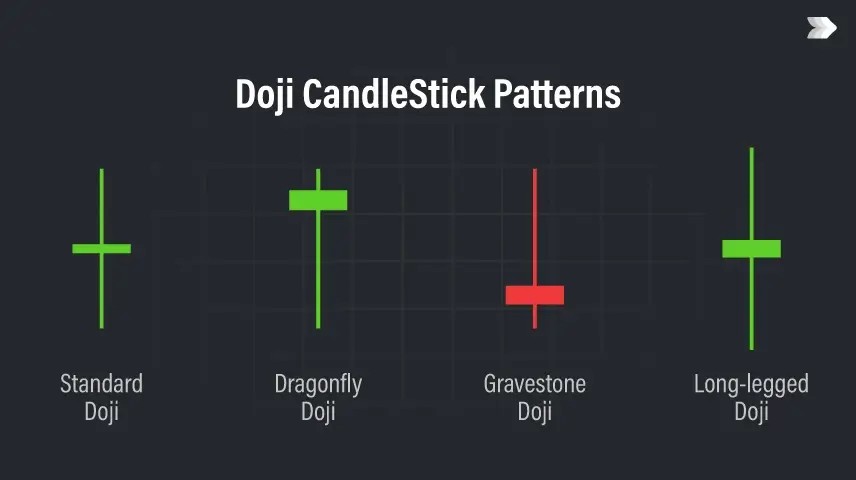
A doji forms when the open and close are almost the same. It shows hesitation and a balance between buyers and sellers.
Pinbar Candlestick

A pinbar has a small body near the top with a long lower wick. It often appears after a drop and signals buyers stepping in.
Spot trend, support, and resistance
How to Spot the Trend
Up-trend = higher highs + higher lows.
Down-trend = lower highs + lower lows.
You can draw a trendline by connecting lows in an up-trend or highs in a down-trend.
Support & Resistance
Support is a price level where buying interest tends to appear (price stops falling and often bounces).
Resistance is a level where selling interest appears (price stops rising and often reverses).
Look for previous highs/lows, congestion areas, and places where the price reversed before.
Support and resistance often take more rules to define - in the trading academy, Simon uses institutional value zones, which are support and resistance with additional rules.

Understand key indicators & what they tell you
Indicators help you read price behavior with a little more clarity. They’re not signals by themselves, but they give you context when you combine them with candles, trend, and volume. Keep your chart clean. Two or three indicators are more than enough for beginners.
Moving Averages (MA)
Moving averages smooth out the price so you can see the direction without noise. They help you spot trend strength, pullbacks, and potential momentum shifts.

Volume
Volume shows how active a stock is during each candle. Rising volume means more participation. In day trading, strong moves usually come with strong volume. Weak volume often leads to weak follow-through.

Momentum Indicators / Oscillators (RSI & MACD)
Momentum indicators help you see when price is stretched, slowing, or shifting. RSI shows when conditions are overbought or oversold. MACD shows momentum changes through crossovers and histogram shifts.

Recognize chart patterns day traders use
Chart patterns help you understand how traders are reacting at key prices. You’re not predicting the future. You’re reading behavior. Patterns show whether buyers or sellers have control, whether price is resting, or whether a trend might be getting tired.
Most patterns fall into two groups: continuation and reversal. Learning to spot both makes it easier to plan entries, exits, and stop placements.
Continuation Patterns

These show up when a trend pauses but hasn’t reversed. Price takes a quick “break,” gathers volume, and often continues in the same direction.
Flags
A flag forms after a strong move. Price then pulls back in a small, tight channel. When the pattern breaks, the trend often continues.

Reversal Patterns
These patterns show that the current trend might be running out of steam. They help you spot moments when buyers or sellers lose control.
Head and Shoulders
This pattern has three peaks: a left shoulder, a higher middle peak (the head), and a right shoulder at about the same height as the left. A break below the neckline often signals a trend shift.

Double Top
A double top forms when the price hits the same high twice and fails to break through. The second rejection often signals weakness.

Double Bottom
A double bottom is the opposite. Price hits a low, bounces, then retests the same low and holds. That second hold shows buyers stepping in.

How Beginners Should Use Patterns
Patterns help you plan, but they don’t replace confirmation:
Wait for the breakout, not the setup alone
Look at higher timeframes to check for higher timeframe points of interest
Keep your stop-loss outside the noise
Patterns become easier to read once you start seeing them repeat. Stick with simple ones first. Over time, they’ll help you understand the story the price is telling.
Common pitfalls day traders make with charts
Beginners often make the same mistakes when they start reading charts. Most issues come from rushing, adding too much to the screen, or ignoring their own rules. This quick table helps you see the biggest traps and how to avoid them.
When to Use Each Tool and Make Decisions
Charts give you signals, but you still need to know when to act. These common situations show you how traders use levels, patterns, and trend tools to make decisions without guessing.
Situations you’ll see on your chart:
Final note
Charts won’t give you perfect signals, but they will help you read behavior and make cleaner decisions. You’ll start seeing how prices move, where traders react, and which levels matter. With practice and steady review, chart reading becomes part of your routine, and your decisions get clearer.
If you want structured steps, example setups, and weekly strategy breakdowns, you can learn more inside The Trading Cafe. It’s built for beginners who want simple rules, chart examples, and real patterns that show up every day.