
M and W Pattern Trading: How to Identify and Interpret the Chart Signals
Summary
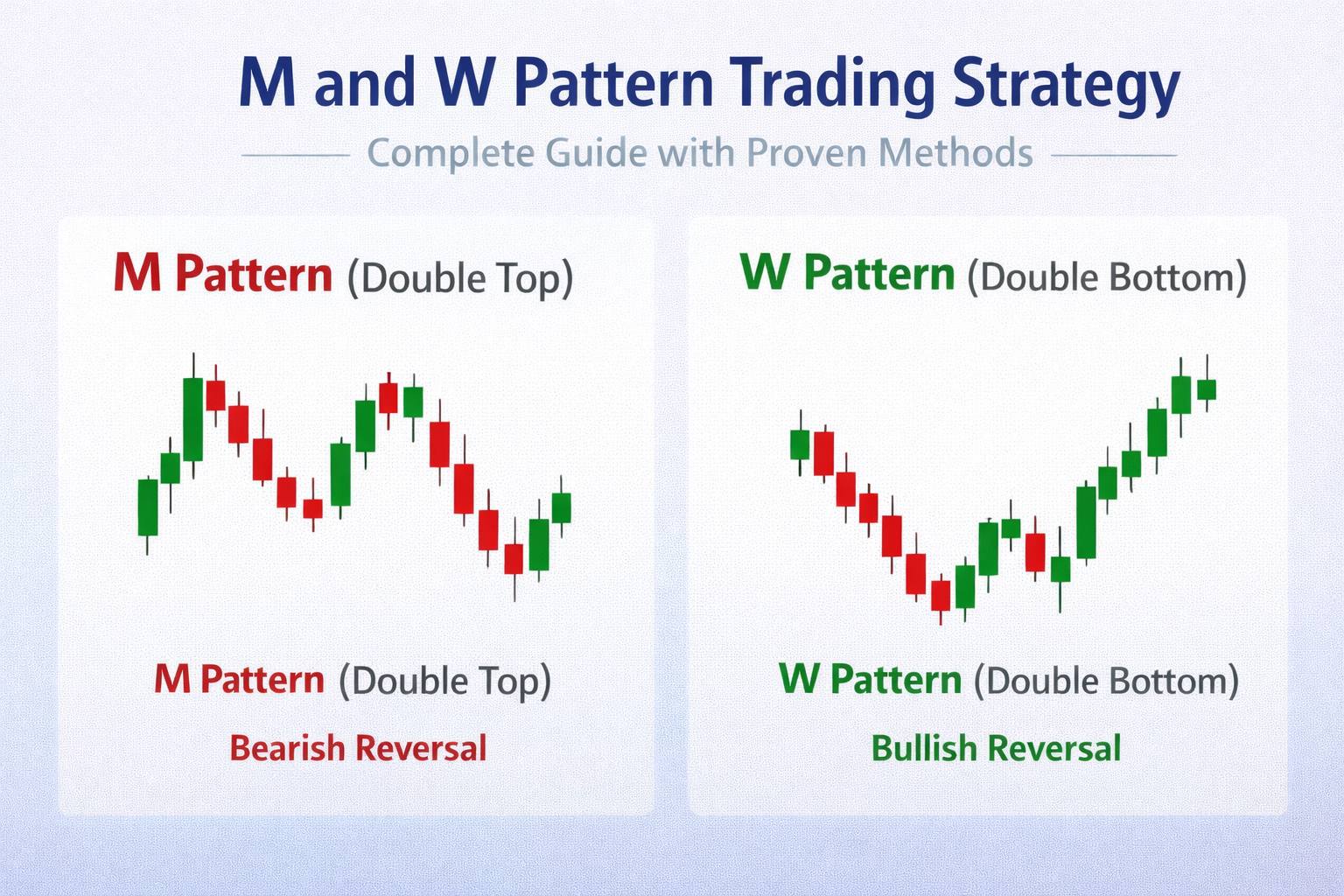
M Pattern Trading (Double Top): Indicates a bearish reversal, appearing after an uptrend. Price forms two peaks at similar levels with a pullback between them. Breaking the neckline (lowest point between peaks) confirms the entry signal. Traders place stop-loss above the pattern and target 1:1 risk-reward, which often lands where the impulsive move began.
W Pattern Trading (Double Bottom): Represents a bullish reversal, forming after a downtrend. Price creates two troughs at similar levels with a bounce between them. Breaking the neckline (highest point between troughs) triggers the trade. Stop-loss goes below the pattern with 1:1 target as the sweet spot.
Pattern Requirements: Valid M and W patterns need 7-30 candles, clean impulsive moves, pullbacks less than 50%, and clear necklines. The pattern completion level must fall within the original impulsive move's range.
Timeframe Flexibility: Most effective on 1-hour charts (20-30 setups weekly) and 4-hour charts (5-8 setups weekly). The 15-minute timeframe isn't recommended due to spread issues eating into profits, but can be traded with a raw spread account.
Risk Management Focus: Never risk more than 1-2% per trade. The 1:1 risk-reward ratio is the sweet spot for M and W patterns, producing 70%+ win rates when validation criteria are met.
Pattern Reliability: M and W patterns are some of the most trusted reversal setups in trading as they reflect shifts in institutional market behavior. According to Investopedia, the double top (M pattern) and double bottom (W pattern) are fundamental chart formations that signal a change in market direction, often confirming a trend reversal. This makes them valuable tools in predicting price movements with high accuracy when properly validated.
Critical Success Factor: Always check for roadblocks (support/resistance levels) between entry and target before taking trades. This single step separates profitable traders from those who struggle.
What M and W Patterns Are
M and W patterns are reversal formations that show up on price charts when an existing trend is losing momentum. The M pattern looks like the letter M and signals a bearish reversal. The W pattern looks like the letter W and signals a bullish reversal.
Double tops and double bottoms work because they show repeated tests of a key level and a failure to continue in the original direction. The second test reveals whether buying or selling pressure is weakening. When price fails to break through and then reverses with momentum, it signals a shift in control between buyers and sellers. That shift in supply and demand is what creates the pattern on the chart.
What makes M and W patterns powerful is the mirror image effect. The angle price climbs often matches the angle it drops.
VIDEO: Watch the Complete M and W Pattern Breakdown
See exactly how M and W patterns form in real markets, why they work, and how to trade them with precise entry and exit rules.
The M Pattern (Bearish Reversal)
The M pattern appears after an uptrend and signals that buyers are losing control. Here's how it forms:
The impulsive move up: Price rallies strongly, often with a series of large bullish candles. This is institutional buying pushing price higher. The best patterns have clean, aggressive moves with all green candles and no interruptions.
The pullback: Price retraces less than 50% of the impulsive move. This pullback represents profit-taking and temporary sellers entering the market. But the pullback shouldn't go too deep. If it retraces more than halfway, the pattern loses its power.
The second peak: Price rallies again to a level similar to the first peak. This is the final attempt by buyers to push higher. But notice something crucial: the second peak typically doesn't exceed the first peak by much, if at all. This shows weakening buying pressure.
The neckline break: Price drops below the lowest point between the two peaks. This is your neckline. When price breaks through this level, sellers have taken control. The reversal is confirmed.
Why the M Pattern Works
A double top forms when price attempts to break a prior high but fails to attract enough new buyers. The second rejection signals weakening demand. When the neckline breaks, it confirms that sellers have gained control of the auction. When price breaks the neckline, you're seeing the beginning of an aggressive sell-off.
The mirror image principle applies here. If price climbed at a 45-degree angle to form the pattern, it often drops at a similar 45-degree angle after the neckline breaks.
The W Pattern (Bullish Reversal)
The W pattern is the opposite of the M. It appears after a downtrend and signals that sellers are losing control. Here's the formation:
The impulsive move down: Price drops aggressively, often with large bearish candles. Clean patterns show strong momentum with all red candles pushing lower.
The bounce: Price retraces less than 50% of the impulsive move down. This bounce shows some buyers entering, but not enough to reverse the trend yet. The bounce shouldn't be too large or the pattern loses effectiveness.
The second low: Price drops again to a level similar to the first low. This is the final attempt by sellers to push lower. But the second low typically doesn't go much below the first low, showing weakening selling pressure.
The neckline break: Price rises above the highest point between the two lows. This is your neckline. When price breaks through, buyers have taken control. The reversal is confirmed.
Why the W Pattern Works
The W pattern forms when price tests a key low twice and fails to continue lower. The first low shows strong selling pressure. The second low shows that sellers are no longer able to push price to new lows with the same strength. When price breaks above the neckline, it confirms that buyers have gained control of the auction and momentum has shifted upward.
The mirror effect often appears here as well. If price declined at a steep angle into the pattern, it can rally at a similar angle after the neckline breaks, reflecting a sharp transition from aggressive selling to aggressive buying. The trade is based on that observable shift in supply and demand.
How to Identify Valid M and W Patterns
Not every double top is an M pattern. Not every double bottom is a W pattern. You need specific criteria to separate high-probability setups from patterns that will fail.
Pattern Requirements
A valid M or W pattern must have these components:
Minimum 7 candles, maximum 30: If the pattern forms in less than 7 candles, it's too fast and likely unreliable. If it takes more than 30 candles, it's too slow and the momentum has dissipated. The ideal patterns form in 10-20 candles.
Clean impulsive move: The initial move (up for M, down for W) should be aggressive with large candles. Ideally, you see all green candles for an M pattern's first move, or all red candles for a W pattern's first move. Interruptions with opposite-colored candles weaken the pattern.
Pullback less than 50%: Measure the impulsive move from its start to its end. The pullback should retrace less than halfway. If it retraces more than 50%, the pattern is invalidated. A deep pullback suggests the original trend still has strength.
The 40% Rule for Optimal Patterns: While 50% is the maximum acceptable pullback, the best M and W patterns have pullbacks of 40-45% or less. This ensures you have plenty of room for pattern completion. To measure correctly: identify the impulsive move from the body of the starting candle to the lowest point (including wicks unless they're rogue wicks sticking way out). Then measure the pullback from that lowest point back up to where the pullback ends (using candle bodies). If the pullback is more than 40-45%, your 1:1 target might fall outside the impulsive move range, weakening the setup.
VIDEO: Understanding the 40% Pullback Rule for M&W Patterns Watch this detailed explanation of how to measure the 40% pullback correctly and why it ensures your pattern completion level stays within the impulsive move.
Second peak or trough at similar level: The two peaks in an M pattern should be at roughly the same price level. Same for the two troughs in a W pattern. They don't need to be exact, but they should be close. If the second peak is significantly higher or lower, the pattern doesn't work.
Clear neckline: The neckline for an M pattern is the lowest point between the two peaks (the lowest candle bodies, not wicks). For a W pattern, the neckline is the highest point between the two troughs (the highest candle bodies). This level must be clear and unambiguous.
The Pattern Completion Level
Here's a rule most traders miss: your take-profit target must fall within the bodies of the impulsive move. If your target is below the start of an M pattern's impulsive move, the setup is invalid. If your target is above the start of a W pattern's impulsive move, the setup is invalid.
Why? Because price tends to run out of momentum once it retraces back to where the impulsive move started. You'll often see price reverse right at that level. So your target needs to be reached before price gets there.
This is called the pattern completion level. It's where you expect price to reach based on a 1:1 risk-reward ratio. Check this level against the impulsive move. If the pattern completion level falls outside the impulsive move's range, skip the trade.
KEY INSIGHT: The mirror image principle - When you put a mirror down the center of an M or W pattern, the angle up often equals the angle down. This happens repeatedly in real markets. This is why these patterns work so consistently when you identify them correctly.
The Trading Cafe M and W Method
At The Trading Cafe, we use a systematic approach to M and W pattern trading. You identify specific conditions that produce consistent results instead of guessing where price might reverse.
Step 1: Scan for Patterns
Monitor your watchlist for M and W formations. You need a watchlist of 40+ instruments across different markets (forex pairs, commodities, indices). This ensures you always have opportunities.
Look for patterns in the forming stage. When you see an impulsive move and a pullback starting, flag that instrument. Mark it so you can monitor it as the second peak or trough develops. Don't wait until the pattern is complete to notice it.
Step 2: Validate the Pattern
Before you trade any M or W pattern, ask these questions:
Does it have at least 7 candles but fewer than 30?
Was the impulsive move clean and aggressive?
Is the pullback less than 50% of the impulsive move?
Are the two peaks (M) or troughs (W) at similar levels?
Is the neckline clear and unambiguous?
Does the pattern completion level fall within the impulsive move?
If you answer no to any of these, skip the pattern. Wait for better setups.
Step 3: Check for Roadblocks
This step separates profitable traders from those who struggle. Look at the price action between your entry (neckline break) and your target (pattern completion level). Are there any support or resistance levels in the way?
Zoom out to higher timeframes. Check if price has reversed at any levels within your trade path. If you see strong support or resistance blocking your way to target, skip the trade. Price will likely bounce at that level instead of reaching your target.
Pay special attention to the neckline itself. If the neckline is a strong support or resistance level, the pattern is more likely to fail. Price might wick through the neckline but immediately reverse back up, stopping you out.
Step 4: Do Your Due Diligence
Before you enter, know exactly what you'll do at every stage of the trade. Where's your entry? Where's your stop-loss? Where's your target? What levels might cause price to pause? Will you manage the trade around those levels or let it run?
Answer all these questions before the neckline breaks. This removes emotion from the equation. You won't panic when price moves against you. You won't exit early when price reaches a minor level. You've already decided everything in advance.
Step 5: Set a Pending Order
You don't need to sit at your computer waiting for the neckline to break. Set a pending order just below the neckline for M patterns, or just above the neckline for W patterns.
When price breaks through, your order executes automatically. This lets you trade even when you're not watching the charts. It also removes the temptation to second-guess your analysis when the moment arrives.
Entry and Exit Rules for M and W Patterns
The Trading Cafe method has specific rules for entries, stop-losses, and take-profits. Follow these exactly.
Entry Rule
Enter when price breaks the neckline. This is crucial: you enter on the break, not on the close below or above the neckline. Many traders wait for a candle to close beyond the neckline. That's too late. You miss the best entry price.
The break happens the moment price pushes through the neckline level. That's your trigger. Use a pending order placed 1-2 pips beyond the neckline to catch this automatically.
Stop-Loss Placement
Your stop-loss goes just beyond the pattern structure. For M patterns, place it above the highest peak (plus a small buffer). For W patterns, place it below the lowest trough (minus a small buffer).
How much buffer? It depends on your broker's spread. If you have a tight spread (0.2-0.5 pips), you can use a smaller buffer of 3-5 pips. If your spread is wider (2-3 pips), use a buffer of 8-10 pips.
You can ignore rogue wicks. If one candle has an extreme wick that sticks out far beyond the pattern, don't place your stop beyond that wick. Place it beyond the main body of the pattern instead. Rogue wicks are outliers caused by low liquidity or spread widening. They don't represent real market structure.
Take-Profit Rule: The 1:1 Sweet Spot
Target a 1:1 risk-reward ratio. If you're risking 30 pips, target 30 pips. This might seem conservative, but it's the sweet spot for M and W patterns.
Why 1:1 works:
These patterns move quickly to target. You don't sit in trades for days.
The win rate is high (70%+) when you follow the rules correctly.
With a 70% win rate and 1:1 ratio, you're profitable: 7 wins = +7R, 3 losses = -3R, net = +4R
Patterns often stall or reverse exactly at the 1:1 level
You can target more aggressive ratios (2:1 or 3:1) if the chart is clean with no roadblocks. But the default should be 1:1. It's consistent and reliable.
Trading Cafe M and W Checklist
Pattern has 7-30 candles
Impulsive move is clean and aggressive
Pullback is less than 50% of impulsive move
Second peak/trough is at similar level to first
Neckline is clear
Pattern completion level falls within impulsive move
No roadblocks between entry and target
Neckline is not a strong support/resistance level
Entry: break of neckline (pending order set)
Stop-loss: beyond pattern structure (plus buffer)
Target: 1:1 risk-reward
If all 11 items check out, take the trade. If even one is missing, skip it.
Why M and W Patterns Fail
Even perfect-looking M and W patterns fail sometimes. Here's why, and how to avoid these setups.
Reason 1: Roadblocks in the Path
This is the number one reason patterns fail. Price breaks the neckline, drops a bit, then hits a support level and bounces right back up. You get stopped out.
Before taking any M or W trade, scan the path between your entry and your target. Look for previous price reactions. If you see price reversed strongly at a level in your path multiple times, that's a roadblock. Skip the trade.
The neckline itself can be a roadblock. If the neckline has acted as strong support or resistance in the past, the pattern is more likely to fail. Price might break through briefly but then reverse immediately.
Reason 2: Pattern Goes Sideways
Sometimes a pattern forms correctly, but then price just sits at the neckline, moving sideways for hours or even days. The pattern loses its power.
M and W patterns work because of momentum. When price breaks the neckline, the momentum should carry it to target quickly. If price stalls and goes sideways, that momentum is gone. The trade becomes a coin flip.
If your pattern sits at the neckline for too long without breaking through, remove your pending order. The setup is no longer valid.
Reason 3: Spread Issues
Broker spreads can kill M and W trades, especially on lower timeframes. If you're trading a 15-minute chart and your stop-loss is 8 pips, but your broker spread is 2 pips, you need to travel 10 pips to breakeven. Meanwhile, you only need to go 8 pips to hit your stop. The math doesn't work.
Rule: Your broker spread must be less than 10% of your stop-loss distance. If your stop is 20 pips away, your spread needs to be 2 pips or less. If your stop is 50 pips away, your spread can be up to 5 pips.
This is why 15-minute M and W patterns are difficult. The stop-losses are too small relative to typical spreads. Stick to 1-hour charts or higher.
Reason 4: Market Volatility
Certain times of day produce unreliable patterns. The most dangerous time is spread hour (10pm-11pm UK time, 5pm-6pm EST). During this hour, the US session closes and the Asian session hasn't opened yet. Liquidity drops dramatically. Spreads widen from 2 pips to 20-30 pips.
If you're in a trade during spread hour, you might think you're 20 pips in profit. Then spread widens to 30 pips and you get stopped out. The price didn't actually move against you. The spread just expanded.
Also be careful around market opens, especially the US open (2:30pm UK time, 9:30am EST). The first 15-30 minutes often see whipsaw action as institutions fill client orders. Patterns that break their neckline right at market open are less reliable.
Reason 5: Pattern Invalidation
Sometimes what looks like a complete M or W pattern develops a new peak or trough. This invalidates the original pattern.
For M patterns: if price makes a new high beyond your second peak, you no longer have an M pattern. You need to reassess and potentially identify a new neckline.
For W patterns: if price makes a new low beyond your second trough, the W pattern is invalidated. You need to wait for a new pattern to form.
This is why you should do your analysis as the pattern develops, not after it's complete. If you notice a new peak or trough forming, you can avoid the trade before it becomes invalid.
WARNING: The biggest trap is seeing a beautiful M or W pattern and taking the trade without checking for roadblocks. You watch the price break the neckline perfectly. Then it drops 10 pips and bounces right back up at a support level you didn't notice. You get stopped out. This happens to everyone at first. The solution? Always check the path to your target before entering.
Best Timeframes for M and W Pattern Trading
M and W patterns work on any timeframe. But some timeframes are better than others for consistent profitability.(see our best computer setup guide including timeframes for use cases)
1-Hour: The Sweet Spot
The 1-hour chart is ideal for M and W patterns. You get 20-30 trade setups per week across 40 instruments. That's enough opportunity to stay active without being overwhelmed.
On the 1-hour, stop-losses are typically 15-30 pips. With a 2-pip spread, that's only 6-13% of your stop distance. The math works in your favor.
Patterns on the 1-hour also move to target relatively quickly. Most trades resolve within 4-12 hours. You're not sitting in positions for days wondering if they'll work out.
4-Hour: Also Good
The 4-hour chart produces 5-8 setups per week. Fewer opportunities, but each pattern is higher probability because you're trading bigger swings.
Stop-losses on the 4-hour are typically 40-80 pips. With a 2-pip spread, that's only 2-5% of your stop distance. Spread becomes almost negligible.
Trades take longer to resolve (12-48 hours), so you need patience. But the 4-hour is perfect if you can't watch charts all day. Patterns develop slowly enough that you can check twice a day and catch good setups.
15-Minute: Not Recommended
The 15-minute chart produces lots of patterns. But most aren't worth trading. Stop-losses are typically 8-15 pips. With a 2-pip spread, that's 13-25% of your stop distance. You're fighting an uphill battle.
Price also needs to travel further to reach its target than it does to hit your stop. If your stop is 10 pips away and your spread is 2 pips, you need to go 12 pips to reach a 1:1 target. But you only need to go 10 pips to get stopped out. The math doesn't work.
Stick to 1-hour or higher for M and W patterns.
Daily and Weekly: Rarely
Daily and weekly charts produce very few M and W setups. Maybe 1-2 per month across all your instruments. But when they do appear, they're powerful.
The challenge with higher timeframes is patience. A pattern might take weeks to develop fully. You need conviction to hold through that process. Most traders are better served focusing on 1-hour and 4-hour charts.
How to Manage Risk When Trading M and W Patterns
M and W patterns give you an edge. But without proper risk management, you'll still lose money.
Position Sizing
Never risk more than 2% of your account on a single M or W trade. 1% is even better when you're starting out.
Here's the formula:
Your risk amount ($100 in this example) is the MAXIMUM you can lose. Not your position size. Many beginners confuse these and end up over-leveraged.(See our beginner’s guide for day trading)
Maximum Open Trades
Limit yourself to 2% maximum total risk exposure at any one time on correlated positions. More than that and you're over-exposed. If the market conditions change and patterns start failing, you'll take multiple losses simultaneously.
Quality over quantity. With 20-30 setups per week on the 1-hour, you can be selective. Wait for the best patterns that meet all your criteria.
Never Move Your Stop-Loss
Set your stop when you enter the trade and never move it further away. If price is about to hit your stop, that means the pattern failed. Accept the loss.
Moving your stop-loss further away turns a small loss into a large loss. It destroys your risk-to-reward ratio. And it usually doesn't save the trade. The pattern failed. Moving your stop won't change that.
Take Your Profits
When price hits your 1:1 target, exit. Don't get greedy and try to squeeze more out of the trade. M and W patterns work because they hit target quickly and consistently. If you start holding for 2:1 or 3:1, your win rate will drop and you'll give back profits.
The 1:1 target is the sweet spot. Trust the system.
KEY POINT: Blown accounts don't happen because the strategy failed. They happen because traders ignored risk management. They risked 10% on one trade because they were "sure" it would work. They moved their stops when price went against them. They held winners too long hoping for bigger profits. Don't be that trader. Follow the rules even when it's uncomfortable.
How to Practice M and W Patterns
Reading about M and W patterns is different from spotting them in real-time. You need a practice system that builds your pattern recognition skills.
VIDEO: Learn the Complete Practice System
Watch this step-by-step walkthrough on how to backtest M and W patterns effectively using TradingView's bar replay feature and build a library of examples that develop real trading confidence.
Use Bar Replay Mode
TradingView has a bar replay feature that hides future price data. This simulates real-time trading. You can practice identifying patterns without knowing what happens next.
Here's how to use it:
Open TradingView and select a currency pair
Go back 6-12 months in time
Click the bar replay button (looks like a play icon)
Price data after your selected date will be hidden
Now identify M and W patterns as they form
Play forward one candle at a time or speed it up
This builds your ability to spot patterns in their forming stage, not just after they're complete. That's the skill that makes money.
Document Everything
Don't just practice mentally. Document every pattern you find in a spreadsheet. This is what separates traders who improve from those who spin their wheels.
Create a simple spreadsheet with these columns:
Pattern number
Currency pair
M or W pattern
Screenshot link
Date identified
Did it reach its target? (Yes/No)
When you spot a pattern in bar replay, take a screenshot using TradingView's camera icon. Paste the screenshot link into your spreadsheet. Then play forward and see if the pattern reached the target.
After documenting 50-100 patterns, you'll start seeing which types work best. You'll notice your common mistakes. This feedback loop is how you improve faster than 95% of traders.
Start Simple
Don't try to learn the entire M and W method at once. Break it down into single elements.
Week 1: Just spot M tops and W bottoms. Don't worry about entries or exits. Just practice identifying the patterns.
Week 2: Add neckline identification. Mark the neckline on each pattern you find.
Week 3: Add validation criteria. Check if patterns have 7-30 candles, clean impulsive moves, pullbacks less than 50%.
Week 4: Add roadblock assessment. Check the path from entry to target.
Week 5: Put it all together and simulate full trades.
This progression builds competence step by step. You're not overwhelmed trying to remember 10 things at once.
Test Across Market Conditions
Go back to major market events and see how M and W patterns performed. The 2008 crash. The 2020 COVID drop. Brexit. These volatile periods test whether the method holds up across different conditions.
When you see patterns working even during extreme volatility, you build conviction in the method. This trust is what allows you to take trades confidently when opportunities appear.
Final Thoughts
M and W patterns work because they show you the exact moment price shifts direction. You're not guessing where the price might reverse. You're identifying specific formations that consistently produce the same result.
But like any strategy, it only works if you apply it correctly. You need to validate patterns with strict criteria. You need to check for roadblocks. You need to use the 1-hour timeframe where spreads don't kill your edge. You need proper risk management. And you need to practice until pattern recognition becomes second nature.
Most traders fail because they skip these steps. They see one good example and think they're ready. Then they lose money and blame the strategy. Don't be like them.
At The Trading Cafe, we teach you to practice first. Document 300 patterns using bar replay. Build your pattern recognition skills. Then paper trade for another 50 setups. Only after you've proven consistency in practice do you risk real money.
This is how you develop real skill instead of gambling on pretty charts.
Join us at The Trading Cafe and learn M and W pattern trading the right way.