
How Much Money Do You Need to Start Day Trading in 2026?
Summary
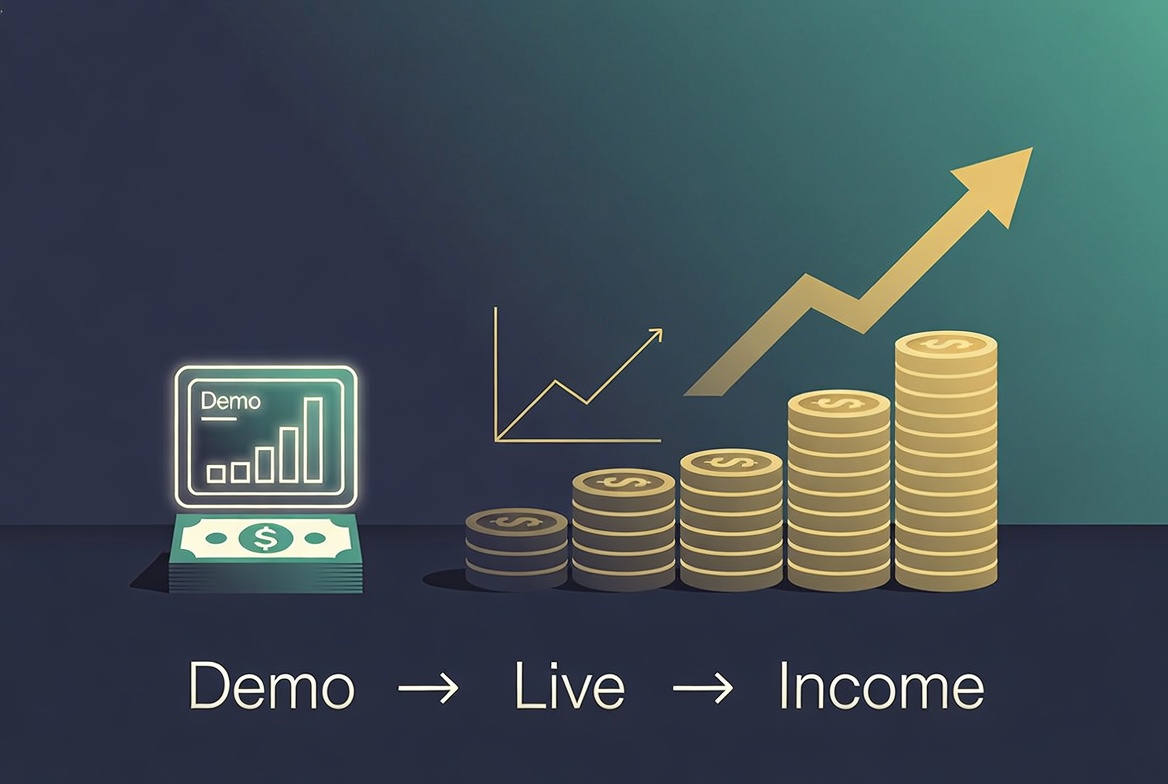
Three Capital Requirements Based on Your Stage: Day trading capital needs depend on your goal. Learning requires $0 (free demo accounts let you practice with fake money in real markets). Starting live trading requires $500-2,000 (enough to trade micro positions and learn real money emotions). Trading for income requires $50,000+ (generating livable monthly income at realistic 5% returns).
Demo Accounts Are Essential and Free: Every broker offers free demo accounts where you trade real markets in real-time with virtual money. You should spend 3-6 months here minimum, taking 100+ trades before risking real capital. Demo practice teaches platform operation, strategy execution, cost calculations, and partial emotional control. The only thing it doesn't teach is real money psychology - but you address that next with small live positions.
Costs Scale with Position Size, Not Account Size: This is critical. A $1,000 account trading 1 micro lot pays the same spread as a $100,000 account trading 1 micro lot. Beginners destroy accounts by trading position sizes too large for their capital - a $2,000 account using standard lots gets crushed by costs. The solution is proper position sizing using the 1% risk rule, which keeps costs at 0.2-2% of your account regardless of account size.
The PDT Rule Only Applies to US Stocks: The Pattern Day Trader rule requires $25,000 minimum if you make 4+ day trades in 5 business days in a US stock margin account. This rule doesn't apply to forex, futures, crypto, or cash accounts. Forex is ideal for beginners with limited capital because there's no PDT restriction and you can start with $500-1,000 using micro lots.
Why 95% Fail (It's Not the Capital): Statistics show 95% of day traders lose money, but insufficient capital isn't the reason. Traders fail because they skip demo accounts and jump straight to live trading, trade position sizes too large for their accounts, lack trading plans, make emotional decisions, expect unrealistic returns (50% monthly instead of realistic 3-5%), and quit after 3 months when the learning timeline is actually 12-18 months.
The Realistic Timeline: Months 1-6 in demo (100+ trades, prove strategy works), month 7 transition to small live account ($500-2,000), months 7-18 continue small live trading (prove real money profitability), after 18+ months scale up gradually if consistently profitable. This progression lets you develop skills without destroying capital. Skipping steps guarantees failure.
Why $50,000 for Income: The $50,000 requirement isn't about handling costs - proper position sizing makes costs manageable at any account size. It's about income generation. A 5% monthly return (excellent by professional standards) on $25,000 generates $1,250/month. After taxes, living expenses, and saving to grow your account, this isn't sustainable. On $50,000, that same 5% generates $2,500/month - enough to live on while continuing to grow.
Capital by Market Type: Forex requires $500-1,000 minimum to start live (micro lots available, no PDT rule, best for beginners). US stocks require $1,500-2,000 to start below PDT threshold or $25,000+ for active day trading. Futures require $1,500-3,000 minimum (no PDT rule but more complex). Choose based on your capital level and which market interests you most.
The Three Capital Stages
Understanding which stage you're in determines your capital requirements. Most beginners fail because they try to skip directly to Stage 3 without proving competence in Stages 1 and 2.
Stage 1: Learning Capital ($0 - Demo Account)
Demo accounts are completely free and available from every reputable broker. You're trading the real market in real-time with virtual money. The charts, prices, spreads, and execution are identical to live trading - only the money is fake.
You should spend 3-6 months minimum in demo before risking real capital. This isn't optional or recommended - it's essential. The traders who skip this step are the ones who blow up accounts and quit claiming "trading doesn't work."
What you learn in demo:
Platform operation - how to place orders, set stops, modify positions, close trades. This sounds basic but fumbling with platform controls during live trades costs real money.
Strategy execution - taking entries according to your rules, placing stops correctly, exiting at targets. You need mechanical competence before adding real money pressure.
Cost calculations - understanding how spreads and position sizing affect profitability. You'll learn that 20 trades per month at 1 pip spread on 1 micro lot costs $2 total, not $200.
Pattern recognition - identifying your setups in real-time as they form, not just in hindsight on historical charts.
Partial emotional control - staying disciplined with virtual money is easier than with real money, but it still requires discipline.
What demo doesn't teach:
Real money emotions. The fear when a trade goes against you with actual capital at risk. The greed when a winner tempts you to hold for more instead of taking profit at your target. The regret after a loss that makes you want to "win it back" immediately.
These psychological elements only emerge with real money. That's why Stage 2 exists - small live trading where losses hurt but don't destroy you financially.
How to use demo effectively:
Open a demo account funded with virtual capital matching what you'll actually start with live - if you plan to start with $2,000, use $2,000 in demo, not $100,000.
Trade exactly as you will live - same position sizes based on 1% risk rule, same entry criteria, same exits. Don't take trades in demo you wouldn't take with real money.
Take 100+ trades minimum. After 50 trades, review results. After 100 trades, if you're not consistently profitable (50%+ win rate with 2:1+ risk-reward), stay in demo longer or change strategies.
Track every trade in a spreadsheet - entry, exit, profit/loss, what went right, what went wrong. This documentation accelerates learning.
The bottom line: You don't need any money to start learning day trading properly. Free demo accounts provide everything you need to develop fundamental skills. Only after proving competence here should you risk real capital.
Stage 2: Starting Live ($500-2,000)
After proving profitability in demo with 100+ trades over 3-6 months, you're ready for small live trading. This stage is about proving you can trade profitably with real money emotions, not about generating income.
Capital requirements by market:
Forex: $500-1,000 minimum. Micro accounts let you trade 1,000-unit positions (micro lots) where each pip equals $0.10. With proper 1% risk rule, a $1,000 account can execute 10-20 trades monthly while keeping costs at 0.2% of capital.
US Stocks: $1,500-2,000 minimum if staying below PDT threshold (3 day trades or fewer per week). With $2,000, you can buy 10-20 shares of $100 stocks, risking 1% ($20) per trade with appropriate stop placement.
Futures: $1,500-3,000 minimum. Micro futures contracts exist for indices, offering smaller position sizes suitable for learning accounts.
Position sizing at this stage:
Risk 1% of your account per trade maximum. With $1,000, that's $10 risk per trade. With $2,000, that's $20 risk per trade.
Calculate position size based on your stop distance. If your stop is 20 pips away and you're risking $10, you can trade 1 micro lot in forex (20 pips × $0.10 per pip = $2 per pip, so 1 micro lot risks $2 × 10 = $20... actually 0.5 micro lots for $10 risk).
Wait - let's recalculate that correctly:
Risk: $10
Stop distance: 20 pips
1 micro lot = $0.10 per pip
Position size needed: $10 risk ÷ 20 pips = $0.50 per pip = 5 micro lots
Start extremely small. Better to trade too small and succeed than trade too large and blow up.
Goals for Stage 2:
Prove you can follow your strategy with real money. Demo success doesn't guarantee live success. The psychological pressure of real money changes everything.
Learn to handle losses without emotional spiraling. Your first real loss will hurt more than you expect. Can you take the loss, analyze what happened, and move on? Or do you immediately try to "win it back" with revenge trades?
Achieve consistent profitability over 50+ live trades. You're not trying to get rich. You're trying to prove this works with real money before scaling up.
Timeline at this stage:
6-12 months minimum. Yes, this feels long. But if you can't be profitable with $1,000, you won't be profitable with $50,000. The account size isn't the problem - your execution and psychology are what matter.
If after 6 months you're not profitable, either stay at this stage longer, return to demo to refine your strategy, or accept that day trading isn't for you.
If after 6-12 months you are consistently profitable (50%+ win rate, 2:1+ risk-reward, 3-5% monthly returns), you can consider adding capital gradually.
Why this stage matters:
Skipping directly from demo to a $25,000 or $50,000 account is how traders blow up. They haven't proven they can handle real money psychology. They haven't experienced the emotional impact of watching $500 or $1,000 disappear in a bad trade.
Small accounts force you to trade properly. You can't afford to be careless. You can't afford revenge trading. You learn discipline because survival demands it.
Stage 3: Trading for Income ($50,000+)
This is the capital level needed to generate livable income from day trading. By the time you reach this stage, you've already proven profitability in demo and small live trading. Now you're scaling up to support yourself financially.
Why $50,000 minimum:
A realistic monthly return for skilled day traders is 3-5%. Professional traders at institutions target 1-3% monthly. Retail traders claiming 20-50% monthly are either lying, taking unsustainable risks, or showing cherry-picked results.
At 5% monthly (which is excellent), $25,000 generates $1,250/month. After taxes (roughly 25-30%), you net $900-950. After living expenses, there's little left to grow your account or handle inevitable losing months.
At 5% monthly on $50,000, you generate $2,500/month. After taxes, you net $1,875-1,900. This is enough to cover modest living expenses while continuing to grow your account.
At 5% monthly on $100,000, you generate $5,000/month, netting $3,750-3,800 after taxes. This is comfortable living income for most people.
Why $25,000 often isn't enough:
The Pattern Day Trader rule requires $25,000 minimum for active day trading of US stocks (4+ day trades per week). But even if you meet this regulatory minimum, the income generated isn't sufficient for most traders.
$1,250/month gross ($900-950 net) requires extremely low living expenses. You're living like a college student, not a professional trader.
You have no buffer for losing months. Every trader has losing months. If you're depending on $1,250 monthly and have a -2% month, you're in trouble.
You can't reinvest to grow the account. Compounding is how accounts grow from $50,000 to $100,000 to $200,000+. If you're withdrawing everything to live on, you never scale up.
At this stage, you've already proven:
Profitability in demo (100+ trades over 3-6 months)
Profitability with small live capital (6-12 months with $500-2,000)
Psychological ability to handle real money trades
Discipline to follow your strategy consistently
Understanding of costs and how position sizing controls them
Adding capital gradually:
Don't jump from $2,000 to $50,000 overnight. Add capital in $5,000-10,000 increments as you prove profitability at each level.
Go from $2,000 to $7,000. Trade for 2-3 months. If profitable, add another $5,000 to reach $12,000. Repeat.
This gradual scaling protects you if your strategy breaks down at larger position sizes or if your psychology struggles with bigger account swings.
Maintain the same 1% risk rule regardless of account size. $2,000 account = $20 risk per trade. $50,000 account = $500 risk per trade. Position sizes scale proportionally.
Trading Costs Explained
The biggest misconception beginners have is that trading costs scale with account size. They don't. Costs scale with position size. Understanding this distinction is critical.
Costs Scale with Position Size, Not Account Size
A $1,000 account trading 1 micro lot pays exactly the same spread as a $100,000 account trading 1 micro lot. The spread is 1 pip either way. On a micro lot, 1 pip equals $0.10. The account size is irrelevant to the cost.
Where beginners destroy themselves is trading position sizes too large for their account. A $2,000 account using 1 standard lot (100,000 units) where each pip equals $10 will pay massive costs relative to account size. Twenty trades per month with a 1-pip spread costs $400 - that's 20% of the account just in spreads.
The same $2,000 account using 2 micro lots (20,000 units total) where each pip equals $0.20 pays dramatically less. Twenty trades per month costs $4 in spreads - just 0.2% of the account.
The solution is proper position sizing using the 1% risk rule.
Real Cost Example for Beginner
Let's walk through realistic costs for a $2,000 forex account:
Account size: $2,000
Risk per trade: 1% = $20
Strategy: Average stop-loss of 20 pips
Position size calculation: $20 risk ÷ 20 pips = $1 per pip. In forex, 1 micro lot = $0.10 per pip, so you need 10 micro lots (100,000 units total) to risk $20 on a 20-pip stop.
Wait, let's recalculate properly:
Risk: $20
Stop: 20 pips
Need: $20 ÷ 20 pips = $1 per pip
1 mini lot (10,000 units) = $1 per pip
Position: 1 mini lot
Spread cost: 1 pip on 1 mini lot = $1 per round trip (entry + exit)
Monthly trades: 20 trades = 20 round trips = $20 in spreads
Monthly cost percentage: $20 ÷ $2,000 = 1% of account
This is completely manageable. If you generate 3-5% monthly returns ($60-100), costs consume $20, leaving you net +$40-80 (2-4% net return).
Cost Example for Intermediate Trader
Now let's scale up to a $10,000 account:
Account size: $10,000
Risk per trade: 1% = $100
Strategy: Average stop-loss of 20 pips
Position size: $100 risk ÷ 20 pips = $5 per pip = 5 mini lots (50,000 units total)
Spread cost: 1 pip on 5 mini lots = $5 per round trip
Monthly trades: 40 trades = $200 in spreads
Monthly cost percentage: $200 ÷ $10,000 = 2% of account
Still manageable. At 5% monthly returns ($500), costs consume $200, netting $300 (3% net return).
Where Beginners Go Wrong
Beginners read about forex offering 100:1 or 500:1 leverage and think this means they should use it. They open a $2,000 account and immediately trade 1 or 2 standard lots (100,000-200,000 units).
With 1 standard lot, each pip equals $10. A 20-pip stop-loss means $200 risk - that's 10% of a $2,000 account on a single trade. This violates every risk management principle.
The spreads also become devastating. Twenty trades per month with 1 standard lot and 1-pip spreads costs $400 monthly - 20% of the account.
The psychology spiral:
Beginner trades too large for account
Costs consume profits or amplify losses
Account bleeds down
Beginner increases position size trying to "make it back faster"
Costs accelerate
Account dies
The solution: Match position size to account size using the 1% risk rule. Calculate position size based on your stop distance and risk amount, not based on how much leverage your broker offers.
Raw Spread Accounts vs Commission Accounts
Most forex brokers offer two account types:
Spread-based accounts: No commission, but spreads are wider (0.8-2 pips on EUR/USD typically).
Commission-based accounts (raw spread accounts): Tighter spreads (0.1-0.4 pips on EUR/USD) but charge commissions per trade ($3-7 per round trip per lot).
For active traders, commission accounts often cost less total. Let's compare:
Spread account:
Spread: 1.5 pips per round trip
40 trades per month with 5 mini lots
Cost: 1.5 pips × $5 per pip × 40 trades = $300
Commission account:
Spread: 0.2 pips per round trip
Commission: $7 per round trip per lot
40 trades × 0.5 mini lots × $7 = $140 commission
Spread: 0.2 pips × $5 per pip × 40 = $4
Total: $144
The commission account saves $156 monthly for an active trader. For beginners making 10-20 trades monthly with micro lots, the difference is minimal. But as you scale up in both frequency and size, commission accounts become more cost-effective.
Check with your broker on their account offerings and calculate which structure costs less for your trading volume.
What Is The PDT Rule
The Pattern Day Trader rule creates confusion for beginners. Understanding what it actually requires helps you plan your trading approach.
What the PDT Rule Is
The Pattern Day Trader rule is a US regulation affecting stock traders using margin accounts.
If you make 4 or more day trades within 5 business days in a margin account, you're classified as a pattern day trader. Once classified, you must maintain a minimum of $25,000 in your account.
A day trade is defined as buying and selling (or selling and buying) the same security on the same trading day.
The PDT rule only applies to:
US stocks
Margin accounts (not cash accounts)
Traders making 4+ day trades within 5 business days
The PDT rule does NOT apply to:
Forex trading
Futures trading
Cryptocurrency trading
Cash accounts (though settlement rules apply)
Traders outside the US (though some brokers apply similar rules)
Workarounds for the PDT Rule
If you have less than $25,000 and want to day trade US stocks, you have options:
Option 1: Trade forex instead
Forex has no PDT rule. You can make unlimited day trades with any account size. This is why forex is ideal for beginners with limited capital. You can start with $500-1,000 and trade as frequently as your strategy requires.
Option 2: Trade futures instead
Futures also have no PDT rule. You can day trade futures with accounts under $25,000. However, futures are more complex than forex and typically require $1,500-3,000 minimum to trade safely.
Option 3: Use a cash account for stocks
Cash accounts aren't subject to the PDT rule. However, you face settlement rules - after you sell a stock, those funds take 2 business days to settle before you can use them again.
This means with a $2,000 cash account, if you day trade on Monday using your full $2,000, you can't trade again until those funds settle on Wednesday. You effectively need to rotate capital or trade less frequently.
Option 4: Limit yourself to 3 day trades per week
If you stay under 4 day trades within 5 business days, the PDT rule doesn't apply. You can day trade occasionally while swing trading the rest of the time.
This hybrid approach works for traders transitioning from swing trading to day trading. You practice day trading 2-3 times weekly while maintaining swing positions.
Option 5: Save up to $25,000
The most straightforward solution: save $25,000 before actively day trading US stocks. Given that $25,000 often isn't enough for income generation anyway (as discussed in Stage 3), this makes sense.
Why $25,000 Often Isn't Enough Anyway
The $25,000 PDT minimum isn't about handling trading costs. Proper position sizing makes costs manageable at any account size. The issue is income generation.
At a realistic 5% monthly return (excellent by professional standards), $25,000 generates $1,250 monthly gross. After taxes (approximately 25-30% depending on your situation), you net $900-950.
Can you live on $900-950 per month? For most people, this doesn't cover rent, utilities, food, transportation, healthcare, and other basic expenses.
You also need to handle losing months. Every trader has months where they're flat or down. If you're depending on that $1,250 monthly income and have a -2% month (-$500), you're now earning $750 gross, $560 net for that month.
You can't reinvest to grow the account. Compounding requires leaving profits in your account to increase position sizes gradually. If you're withdrawing everything to live on, your account never grows. You're stuck at $25,000 forever.
This is why $50,000-100,000 makes more sense for full-time trading income. At these levels, 5% monthly returns generate $2,500-5,000, providing actual living income with room for growth.
Why 95% Fail (It's Not the Capital)
The statistic that 95% of day traders lose money gets cited constantly. But the reasons for failure have nothing to do with insufficient capital.
Real Reasons for Failure
Skipping demo accounts
Most beginners go straight to live trading. They open an account, deposit money, and start trading immediately. They have no practice, no proven strategy, no understanding of costs or position sizing.
This is like trying to drive a car for the first time on a busy highway. You haven't practiced in an empty parking lot. You don't know the controls. You crash.
Demo accounts eliminate this problem. Spend 3-6 months in demo. Prove your strategy works. Learn the platform. Make mistakes with fake money. Then go live with small capital.
Trading position sizes too large for account size
Beginners see forex brokers advertising 100:1 or 500:1 leverage and think they should use it. They trade standard lots on $2,000 accounts. Each trade risks 5-10% of their capital.
One bad day with three losses in a row destroys 15-30% of the account. Recovery from a 30% drawdown requires a 43% gain. The account never recovers.
The 1% risk rule prevents this. Risk 1% per trade maximum. With a $2,000 account, that's $20 per trade. With proper stop placement, this determines your position size automatically.
No trading plan or strategy
Many beginners trade randomly. They see a chart setup that looks good and enter. They have no predefined rules for entries, stops, or exits. They make decisions based on emotions and impulses.
Professional traders have written trading plans specifying:
Which markets and timeframes they trade
Specific entry criteria (their strategy rules)
Stop-loss placement rules
Target or exit rules
Risk per trade (1% maximum)
Maximum open positions
When they don't trade
Without a plan, you're gambling, not trading.
Emotional trading
Revenge trading after losses. FOMO (fear of missing out) entries on moves already done. Holding losers hoping they come back. Cutting winners too early out of fear they'll reverse.
Emotions destroy accounts faster than any strategy flaw. Demo trading can't fully prepare you for real money emotions, which is why small live trading (Stage 2) matters so much.
Unrealistic expectations
Beginners expect 20-50% monthly returns. They see advertisements or YouTube videos showing "$500 turned into $10,000 in one month!" and think this is normal.
Reality: 3-5% monthly returns are excellent. Professional traders at hedge funds target 1-3% monthly. Consistent 5% monthly compounded is 79.5% annually - this is exceptional performance.
When beginners don't hit 20%+ monthly, they think they're failing. They increase risk trying to hit these unrealistic targets. They blow up their accounts.
Giving up too soon
Most beginners quit after 2-3 months of unsuccessful trading. But the realistic learning timeline is 12-18 months from starting demo to consistent live profitability.
Those 2-3 months aren't enough time to develop pattern recognition, refine your strategy, overcome emotional trading, and build the experience needed for success.
Trading is a skill like playing an instrument or speaking a language. You don't become fluent in Spanish after 3 months of practice. You don't become a profitable trader after 3 months either.
What Would Actually Help
3-6 months demo trading minimum
Start with demo. Take 100+ trades. Track results. Prove your strategy works before risking real money.
Proper position sizing (1% risk rule)
Calculate position size based on your account size and stop distance. Never risk more than 1% per trade. This keeps you alive through inevitable losing streaks.
Written trading plan with entry/exit rules
Document your strategy completely. When do you enter? Where do you place stops? When do you exit? What's your risk per trade? Maximum positions? Follow this plan exactly - no improvising.
Realistic expectations (3-5% monthly is excellent)
Adjust your expectations. If you can achieve 3-5% monthly consistently, you're outperforming most professional traders. Compound this over years and you'll build substantial wealth.
Accept the 12-18 month learning timeline
Trading mastery takes time. Plan for 3-6 months demo, then 6-12 months small live trading. After 12-18 months total, if you're profitable, scale up. If you're not profitable, accept it and move on.
The failure rate is high not because trading is impossible, but because most people aren't willing to put in the time and discipline required. Those who follow a structured progression succeed at far higher rates than 5%.
The Proper Progression Path
Success in day trading follows a structured progression. Skipping steps leads to failure. Following this path increases your odds dramatically.
Backtesting Your Strategy (Before Demo)
Before even opening a demo account, backtest your strategy on historical data.
Use bar replay features in TradingView or your trading platform. Hide future price data and trade as if you're seeing the market in real-time. This lets you take 50-100 trades in a few hours, compressing months of live trading into a single session.
Document results. Did your strategy produce profits on historical data? What's the win rate? Average risk-reward? If it doesn't work on historical data, it won't work in demo or live.
Backtesting isn't perfect - you're seeing clean data without the psychological pressure of real trading. But it provides a baseline. If your strategy loses in backtesting, fix it before moving to demo.
Months 1-3: Demo Trading
Open a free demo account with your chosen broker. Fund it with virtual capital matching what you'll actually trade live - if you plan to start with $2,000, use $2,000 in demo.
Practice one strategy only. Don't try to learn five different approaches simultaneously. Master one completely before considering others.
Take 50+ trades during these first three months. Execute your strategy exactly as you will live - same entry criteria, same stops, same exits, same position sizing based on 1% risk.
Track everything in a spreadsheet:
Trade number
Date/time
Market and direction (long/short)
Entry price
Stop price
Exit price
Profit/loss in currency and R (risk multiples)
What went right
What went wrong
Lessons learned
Learn your trading platform thoroughly. Practice placing orders, modifying stops, managing multiple positions. Fumbling with platform controls during live trades costs money.
Calculate costs for your trading style. With your planned position sizes and trade frequency, what will monthly spreads cost? Is this sustainable given your target returns?
Months 4-6: Continued Demo
Take 50+ more trades during months 4-6. You should now have 100+ total demo trades completed.
Refine your strategy based on what's working and what isn't. If certain setups consistently lose, stop taking them. If certain setups consistently win, look for more of them.
Improve your win rate and risk-reward ratios. Your first 50 trades might show a 45% win rate at 2:1 risk-reward. Your next 50 should improve - perhaps 52% win rate at 2.3:1 risk-reward.
Review your trading journal. What mistakes repeat? Are you entering too early or too late? Cutting winners too soon? Letting losers run? Identify patterns in your errors.
At the end of month 6, evaluate objectively. Are you consistently profitable over 100+ trades? Do you follow your rules or improvise frequently? Can you execute your strategy mechanically without hesitation?
If yes - move to small live trading. If no - stay in demo another 2-3 months or consider whether day trading is right for you.
Month 7: Transition to Live (Small)
After proving consistent profitability in demo, open a live account with $500-2,000. Don't jump to $10,000 or $25,000. Start small.
Trade micro lots in forex or tiny share quantities in stocks. Risk 1% per trade exactly as you did in demo. Use the exact same strategy and rules.
Your first few live trades will feel different. The emotional impact of real money is significant even with small amounts. A $10 loss feels worse than a $100 loss in demo. This is normal.
Your goal is handling real money psychology. Can you take a loss without immediately trying to win it back? Can you follow your stop-loss even when you "feel" the trade will reverse? Can you take profits at your target instead of hoping for more?
Execute 10-15 trades in month 7. Focus on following your rules, not on making profits. If you break rules (move a stop-loss, revenge trade, ignore entry criteria), you're not ready for live trading. Return to demo.
Months 7-18: Small Live Trading
Continue trading small for 6-12 months. Yes, this feels long. But you're proving you can consistently trade profitably with real money.
Take 50-100+ trades during this period. Track results as meticulously as you did in demo.
If after 6 months you're consistently profitable (50%+ win rate, 2:1+ risk-reward, generating positive returns), consider adding capital gradually.
Add $3,000-5,000 at a time. Go from $2,000 to $5,000, trade for 2 months, then add another $5,000 to reach $10,000. Scale gradually, proving profitability at each level.
If after 6 months you're not profitable, stay at this stage or return to demo. Figure out what's wrong. Are you not following your strategy? Is the strategy itself flawed? Are emotions sabotaging your execution?
Don't add more capital hoping that will solve the problem. If you can't trade profitably with $1,000, you can't trade profitably with $50,000. The account size isn't the issue.
After 18+ Months: Scale Up (If Profitable)
Only after 18+ months of total trading time (6 months demo + 12 months small live minimum) and proven consistent profitability should you consider scaling to larger capital.
Add capital in $5,000-10,000 increments, not all at once. Going from $10,000 to $50,000 is a big psychological jump. Do it gradually: $10,000 → $20,000 → $30,000 → $40,000 → $50,000 over 6-12 months.
Maintain the same 1% risk rule at all account sizes. $10,000 account = $100 risk per trade. $50,000 account = $500 risk per trade. Your position sizes scale proportionally with your account.
Monitor your performance at each new capital level. Sometimes strategies that worked at $2,000-10,000 break down at $50,000+ due to liquidity issues or psychological pressure from larger dollar swings.
Your goal is reaching $50,000-100,000 for sustainable income generation. At 5% monthly returns, this generates $2,500-5,000 monthly - enough to live on while continuing to grow your account.
This progression takes time - 18-24 months minimum from starting demo to reaching income-level capital. But traders who follow this path have dramatically higher success rates than those who skip steps.
Capital Requirements by Market
Different markets have different capital requirements and characteristics. Choose based on your capital level and interests.
Forex
Minimum to start live: $500-1,000
Forex is ideal for beginners with limited capital. Micro accounts let you trade positions as small as 1,000 units (micro lots) where each pip equals $0.10. This allows precise position sizing even with small accounts.
PDT rule: Doesn't apply. You can make unlimited day trades with any account size.
Leverage: Brokers offer 50:1, 100:1, or even 500:1 leverage. Ignore these high leverage offers. Use 5:1 or less while learning. Higher leverage doesn't increase profits - it just lets you blow up your account faster.
Best for: Beginners with limited capital who want to start live trading after proving profitability in demo. The low capital requirements and lack of PDT restrictions make forex accessible.
Major pairs to trade: Start with EUR/USD (most liquid, tightest spreads). Add GBP/USD or USD/JPY once comfortable. Avoid exotic pairs (wide spreads, low liquidity) until you're consistently profitable with majors.
For a complete guide to starting forex trading, see our forex trading for beginners guide.
US Stocks
Minimum to start: $2,000 (below PDT threshold) or $25,000+ for active day trading
Stock trading offers thousands of instruments to choose from. You can focus on specific sectors, trade based on earnings catalysts, or follow momentum in popular stocks.
PDT rule: Applies if you make 4+ day trades within 5 business days in a margin account. Requires $25,000 minimum once triggered.
Workarounds: Use a cash account (settlement rules apply), limit yourself to 3 day trades per week, or save up to $25,000 before active day trading.
Best for: Traders with $25,000+ capital or those willing to swing trade primarily with occasional day trades. Also suitable for traders who prefer individual company analysis over currency pairs.
Stocks to consider: Focus on liquid stocks trading 5+ million shares daily. Popular day trading stocks include large-caps (AAPL, TSLA, AMZN) and volatile mid-caps with catalysts. Avoid penny stocks (too easily manipulated).
Futures
Minimum to start: $1,500-3,000
Futures offer leverage built into contract specifications. Micro futures contracts (micro E-mini S&P 500, micro gold, etc.) provide smaller position sizes suitable for learning accounts.
PDT rule: Doesn't apply. You can day trade futures with any account size.
Leverage: Built into the contract specifications. A single micro E-mini S&P 500 contract controls $5,000+ of the index. Position sizing comes from choosing the appropriate contract size for your account.
Best for: Intermediate traders comfortable with the additional complexity. Futures require understanding contract specifications, expiration dates, and rollover between contract months.
Contracts to consider: Start with micro index futures (micro E-mini S&P 500, micro Nasdaq, micro Russell). These track major indices with smaller position sizes than standard contracts.
Comparing Capital Needs
Choose based on your capital availability and which market interests you most. If you have $500-1,000, forex is your best starting point. If you have $25,000+, stocks open up. If you have $1,500-3,000 and want to trade indices, futures work well.
Real Math Examples
Let's walk through realistic scenarios showing how costs and returns work at different account sizes.
Example 1: Starting Small (Forex)
Account size: $1,000
Risk per trade: 1% = $10
Strategy: Pullback entries with 20-pip stop-losses average
Position size calculation:
Risk: $10
Stop distance: 20 pips
Needed per pip: $10 ÷ 20 pips = $0.50 per pip
Position size: 5 micro lots (5 × $0.10 per pip = $0.50 per pip)
Spread cost:
Spread: 1 pip on EUR/USD
Cost per round trip: 1 pip × $0.50 per pip = $0.50
Monthly trades: 20
Monthly spread costs: 20 × $0.50 = $10
Monthly cost percentage: $10 ÷ $1,000 = 1% of account
Achievable monthly return: 3-5% = $30-50 gross return
Net after costs: $30-50 - $10 = $20-40 net (2-4% net return)
Realistic? Yes. Costs are manageable with proper position sizing. You're not making significant income, but you're proving you can trade profitably with real money. This is the goal at this stage.
Example 2: Intermediate Trader (Forex)
Account size: $10,000
Risk per trade: 1% = $100
Strategy: Pullback entries with 20-pip stop-losses average
Position size calculation:
Risk: $100
Stop distance: 20 pips
Needed per pip: $100 ÷ 20 pips = $5 per pip
Position size: 5 mini lots (5 × $1 per pip = $5 per pip)
Spread cost:
Spread: 1 pip on EUR/USD
Cost per round trip: 1 pip × $5 per pip = $5
Monthly trades: 40
Monthly spread costs: 40 × $5 = $200
Monthly cost percentage: $200 ÷ $10,000 = 2% of account
Achievable monthly return: 3-5% = $300-500 gross return
Net after costs: $300-500 - $200 = $100-300 net (1-3% net return)
Realistic? Yes. Costs remain manageable even with increased trading frequency. You're generating $100-300 monthly profit - supplementary income but not enough to live on. This demonstrates why larger capital is needed for income generation.
Example 3: Full-Time Trader (Forex)
Account size: $50,000
Risk per trade: 1% = $500
Strategy: Pullback entries with 20-pip stop-losses average
Position size calculation:
Risk: $500
Stop distance: 20 pips
Needed per pip: $500 ÷ 20 pips = $25 per pip
Position size: 2.5 mini lots or 25 micro lots
Spread cost:
Spread: 1 pip on EUR/USD
Cost per round trip: 1 pip × $25 per pip = $25
Monthly trades: 40
Monthly spread costs: 40 × $25 = $1,000
Monthly cost percentage: $1,000 ÷ $50,000 = 2% of account
Target return: 5% = $2,500 monthly gross return
Net after costs: $2,500 - $1,000 = $1,500 monthly
After taxes (30%): $1,500 × 0.70 = $1,050 net monthly income
Realistic? Yes for income generation, though costs are higher in absolute dollars. The key insight: even at $50,000, you're netting $1,050-1,500 monthly after costs and taxes. This is modest income requiring excellent trading performance (5% monthly). This demonstrates why many full-time traders target $100,000+ accounts.
Example 4: Full-Time Trader (Larger Account)
Account size: $100,000
Risk per trade: 1% = $1,000
Strategy: Same 20-pip stops
Position size: $1,000 ÷ 20 pips = $50 per pip = 5 mini lots
Spread costs: 40 trades × 1 pip × $50 = $2,000 monthly
Target return: 5% = $5,000 monthly gross
Net after costs: $5,000 - $2,000 = $3,000
After taxes: $3,000 × 0.70 = $2,100 net monthly income
Now we're seeing comfortable income from trading. At $100,000 account size with 5% monthly returns, you generate $2,100 monthly after costs and taxes. This is sustainable full-time income in many locations.
Key Takeaway from These Examples
Costs as a percentage of your account remain constant (1-2%) when you use proper position sizing based on the 1% risk rule. Whether you have $1,000 or $100,000, if you're risking 1% per trade, your costs are manageable.
The difference is absolute dollar income. $1,000 at 5% monthly generates $50. $100,000 at 5% monthly generates $5,000. Same percentage return, vastly different income.
This is why you need $50,000-100,000 for full-time trading income, not because smaller accounts can't handle costs, but because the absolute dollar returns at smaller sizes don't constitute livable income.
How Much Money Do You Actually Need?
Let's summarize capital requirements based on your specific goal.
To Start Learning: $0 (Demo Account)
You don't need any money to start learning day trading. Every reputable broker offers free demo accounts where you trade real markets with virtual money.
Spend 3-6 months here. Take 100+ demo trades. Prove your strategy works. Learn platform operation and position sizing calculations. Make mistakes with fake money.
Only after consistent demo profitability should you move to live trading.
To Start Live Trading: $500-2,000
After proving profitability in demo, start live with small capital:
Forex: $500-1,000 (micro accounts available, no PDT rule)
US Stocks: $1,500-2,000 (stay below PDT threshold at $25,000, limit to 3 day trades weekly)
Futures: $1,500-3,000 (no PDT rule, micro contracts available)
This capital is for learning to trade with real money emotions, not for generating income. Trade micro positions. Risk 1% per trade. Prove you can follow your strategy under real money pressure.
Expect to spend 6-12 months at this stage before considering adding more capital.
To Trade Part-Time: $10,000-25,000
Once you've proven consistent profitability with small capital, you can scale up to part-time trading levels.
Monthly income at 3-5% returns:
$10,000 account: $300-500 monthly (supplementary income)
$15,000 account: $450-750 monthly
$25,000 account: $750-1,250 monthly
This level lets you generate meaningful supplementary income while maintaining other income sources (job, business, investments). You're not depending entirely on trading to support yourself.
You're also continuing to grow your account through reinvestment, compounding toward $50,000+ for full-time trading if that's your goal.
To Trade Full-Time: $50,000-100,000
To generate livable income from day trading, you need $50,000 minimum, preferably $75,000-100,000.
Monthly income at 5% returns (excellent performance):
$50,000 account: $2,500 gross, ~$1,750 net after taxes and costs
$75,000 account: $3,750 gross, ~$2,625 net
$100,000 account: $5,000 gross, ~$3,500 net
At these levels, you're generating income sufficient to cover living expenses, pay taxes, and continue growing your account.
Note that 5% monthly returns are excellent by professional standards. Many months you'll make less. Some months you'll lose money. The $50,000-100,000 capital level provides buffer to handle volatility while generating average income that supports full-time trading.
The Reality Check
Starting with $500-2,000 and growing it to $50,000-100,000 through trading profits alone takes years. At 5% monthly compounded:
$2,000 → $50,000 requires 32 months (nearly 3 years) of perfect 5% monthly returns with no withdrawals.
$2,000 → $100,000 requires 41 months (over 3 years) at 5% monthly.
Most traders don't compound perfectly for 3+ years straight. They have losing months. They withdraw some profits. Real timelines are 5-10 years from $2,000 to $100,000, if they reach it at all.
The practical path for most traders: Start with $500-2,000 to learn. Add savings gradually as you prove profitability. Combine trading profits with external capital additions (from your job or business) to reach $50,000-100,000 faster than compounding alone allows.
Final Thoughts
You don't need $50,000 to start day trading. You need $0 to learn in demo, then $500-2,000 to start live trading.
You need $50,000-100,000 to generate livable income from day trading. That's a completely different goal requiring proven profitability first.
The progression is clear: Demo trading for free (3-6 months) → Small live trading with $500-2,000 (6-12 months) → Prove consistent profitability → Scale up gradually to $50,000+ for income generation.
Costs aren't the obstacle. Trading costs scale with position size, not account size. Proper position sizing using the 1% risk rule keeps costs at 1-2% of your account regardless of size. Whether you have $1,000 or $100,000, if you're using correct position sizing, costs are manageable.
The real obstacles are: skipping demo practice, trading too large for your account, lacking a written trading plan, making emotional decisions, expecting unrealistic returns, and giving up before completing the 12-18 month learning timeline.
Most traders fail not because they lack capital, but because they skip essential steps in their eagerness to start making money. They go straight to live trading. They risk 5-10% per trade. They have no proven strategy. They quit after 3-6 months when results don't meet expectations.
Those who follow the structured progression - demo for 3-6 months, small live for 6-12 months, gradual scaling after proving profitability - succeed at dramatically higher rates than the 5% average.
The capital isn't the hard part. Anyone can save $500-2,000 over a few months. The discipline, patience, and skill development are the hard parts. Free demo accounts let you develop these before risking real money.
Start with demo. Take 100+ trades. Prove your strategy works. Then start small with $500-2,000. Prove you can handle real money emotions. Only after 12-18 months of proven profitability should you consider scaling to $50,000+ for income.
The timeline feels long. The progression feels slow. But it works. Traders who follow this path build sustainable trading careers. Those who try to skip steps blow up accounts and quit, joining the 95% failure statistic.
Be patient. Start with demo. Prove it works. Then build gradually. The $50,000-100,000 you eventually trade with will still be there after you've proven you deserve to manage it.
Join The Trading Cafe Free School: https://thetrading.cafe